Wednesday, 27 February 2013

Growing up Scratchy - Living with Eczema

For the last 40 years I have lived with a fairly low profile but very high impact disease - eczema.  It's difficult to explain to somebody who doesn't have eczema just how much it affects your life.  Perhaps the best way of explaining what eczema feels like is to explain that it comes from the Greek word 'ekzein' which means 'to boil'.  Eczema at its worst feels like your skin is on fire.  Incredibly 1 in 5 children and 1 in 12 adults in the UK suffer from eczema.  There is loads of different information about the different types of eczema here.

Eczema is a 'non-disease.'  It's not high profile or life threatening so the medical response is patchy and poorly resourced.  I may be paranoid but I can't help feeling that some of the doctors I have seen seem to imply that I could be doing a lot more to help myself.  A recent consultant gave me the third degree for missing my patch tests (we were on holiday at the time).  While this is my own experience our son Alasdair has a very supportive GP and dermatologist at the moment.

I had fairly extreme eczema as a kid but have always suffered with bad eczema on my hands as an adult.  At best it can be irritating but at worst it can be debilitating and can make work complicated.  Last year my hands become infected 5-6 times over the summer and autumn.  Large blisters appeared on my hands and my fingers became infected.  I lost 3 nails on my right hand with the infection and was on non-stop anti-biotics for months.  The result?  After about 25 years away from dermatology I am back on their books. 


The smell of cold tar and the familiar names of dermovate, betnovate and eumovate are part and parcel of the Dermatology Dept at Lauriston and it feels like I've never been away.  There is an almost Victorian feel to the Dermatology Department with a complete absence of any high tech equipment.  The Victorian feel is backed up by the patriarchal system of male doctors giving instructions to an army of female auxiliaries who fetch and carry files and take blood samples from willing victims.  My first visit back to dressings after nearly 25 years away involved red paint being dabbed on my cuts, cold tar smeared on my hands and walking out with mickey mouse gloves.  I had some strange looks as I sipped coffee in the Elephant House before going in to the National Library!

Last Saturday we attended our first family weekend with Eczema Outreach Scotland.  It was great to meet other parents affected by eczema and hear some fairly familiar stories.  The event was in the Howden Park Centre in Livingston and while our boys politely declined the dance workshop they had a great time at the arts and crafts (no. 4 son Ali was a bit scratchy and shy).


As with so many inspirational charities, Eczema Outreach Scotland, was set up by one mother frustrated with how little support there was for families affected my eczema.  The founder is called Magali Speight (pictured below with Kirsteen) whose daughter suffers from eczema.  Magali proves what one person can do with energy and vision.  After only one year the organisation has around 150 families who have received their welcome pack and attended their growing number of events.


Those with kids who have eczema are affected in all sort of ways - from sleep deprivation, food allergies, to endless hospital appointments and the usual round of comments in the supermarket as you explain that your son (or daughter) isn't a burns victim.  Most of us have experienced the frustrations of a less than zealous medical response.  I remember sitting in a consultants office with our 2nd son Calum around 7 years ago.  His face was red raw with weeping sores and he was screaming in pain night after night.  Despite this the consultant said there was nothing else he could do for us.  Not for the last time we walked out of a medical appointment feeling unsupported and very alone. 

Of our 4 boys 3 have eczema with little Alasdair (centre below) being by far the worst.  When we tell people that he has hardly slept all night for the last 3 years, people think we are exaggerating.  He can go through phases when after 2-3 hours of sleep he can be unsettled for the rest of the night.  At times I've gone in to work on 3-4 hours of fitful sleep.  Talking to some other fathers at the event last week, sleep deprivation comes up the most challenging issue.  Some spoke of being in medical jobs where a mistake could lead to disastrous consequences and found little support from their employer.

Is there hope?  Yes there is.  Kids can get better - there is always hope they can grow out of it.  Calum (10), despite having extreme food allergies has almost outgrown eczema apart from the soles of his feet.

Family is a huge help.  James (13) has eczema so has an incredible bond with Ali.  Often he will help him calm down when he is in a scratching fit. Use extended family to get a break, have a meal and have a good sleep!

As a couple it is important to work as a team.  If both of us are having a sleepless night it can be horrendous.  Better that at least one sleeps and the other tries to calm down the scratchy kid or that we take 2 hourly shifts.  All the couples I have spoken to say that having a child with eczema can have a significant impact on your marriage and family life.  Acknowledging this and talking about it can be first step to seeking more support.  If possible get other family involved so that even once a month you can have a full nights sleep.

Organisations like Eczema Outreach Scotland are excellent.  Bringing families together for mutual support is such a help and even though it doesn't solve the problem, at least people feel less alone as they struggle through. 

Assertiveness can help.  Some GP's don't routinely refer eczema sufferers to dermatologists.  If you are struggling, insist on a referral and keep fighting until you get one.  Once you see a specialist you will hopefully remain in the system until things are a little better.

Lastly, and most importantly for us, faith is a huge element of our life with eczema.  We believe in a God who hears and answers prayer and in a Saviour who knew what it was like to suffer.  We don't believe that suffering is meaningless but we believe that 'for those who love God all things work together for good, for those who are called according to his purpose' Romans 8 v 28. 

The Psalms are also a great comfort to us - in them we find a great reality and comfort.  Let me leave you with one of my favourites; 'You who have made me see many troubles and calamities will revive me again; from the depths of the earth you will bring me up again.  You will increase my greatness and comfort me again Psalms 71 v 20, 21. 

Monday, 11 February 2013

A Trip to Murrayfield and the Shiny Bubbles of Fame

We had a great weekend in the Murray house.  Saturday was taken up with a trip to Murrayfield to see the victorious Scotland Rugby Team beat Italy 34-10.  The tickets seemed out of our reach but a very generous benefactor donated some tickets to us.  We were sitting in the gods but Davie and Calum enjoyed their first rugby game all the same.  There was great excitement with some of the tries particularly Stuart Hogg's stunning 80 yard run.


It always amazes me how nearly 80,000 people can watch a rugby game, with no segregation and a plentiful supply of alcohol and yet there is no trouble.  Compared to the aggressive atmosphere of some of the football games I have been at in the past, rugby is a very pleasant day out and one I wouldn't hesitate to take the kids back to.

The weekend got even better when we turned up for church on Sunday and the boys found themselves sitting in front of Euan Murray from the Scotland Squad. 


Murray has never tried to be a celebrity Christian but doesn't shy away from his principles as this Guardian interview proves.  Here are a couple of paragraphs;

He [Murray] suggests that the path many professional sportsmen follow is "rotten". He tries to explain. "All the shiny bubbles," he says, holding out his big hands and shaking his head in sadness. "The money, the possessions, the fame, the great elusive relationship – all bubbles that appear perfectly spherical, all the colours of the rainbow. They're bright and shiny and light as a feather, and you chase them because it's good fun, but the minute you get them they burst and they're empty." He pauses. "I'd had enough of chasing bubbles."

What were the "bubbles"? "The attraction of all the glamour and glitz that society puts up on a pedestal and says is the be all and end all. All the tinsel, you know? The success. There are many ways of measuring success – it could be in popularity, the funniest guy, or the guy with the best scores, it could be money, it could be getting the best-looking girl, lifting the most in the gym, having the best clothes, it could be being the best rugby player in the world." He trails off. "It's not wrong to be funny, or have a great-looking wife. It's not wrong to have money and to want to be the best player in the world, but if that is your idol then that is wrong." (The Guardian, Thursday 4 February 2010).

There are so many stars who pursue the 'shiny bubbles' that Murray describes above and find that as soon as they have them they are empty.  The recent tragedy of Paul Gascoigne is testament to the elusive nature of a celebrity sport lifestyle. 

At the age of 25 Murray had everything that the world could offer and yet he had an emptiness.  After an accident in 2005 when he was knocked unconcious Murray began to read his Bible which began to challenge his lifestyle.  As Murray read about Jesus and the need for the new birth, he began to seek the Lord and came to know Christ in a personal way. 

As well as being open about his faith in Christ, Murray has always stood firm on the Lords Day which is so rare amongst high profile sports people and even most Christians nowadays.  My oldest boy James is a great fan of Eric Liddell so I'm very pleased that the boys have guys like Murray to look up to.  There is more from Ragged Theology on the Lord's Day here.

I know Euan doesn't seek the limelight but if you want to hear more about how he lives as a Christian and a rugby player you can listen to it here

Sunday, 3 February 2013

Lunch with the Vicar of Baghdad

I met a remarkable man last Saturday - Canon Andrew White who ministers at St George's, Baghdad.  His church is involved in a whole variety of ministries through the Foundation for Relief and Reconciliation in the Middle East.  Every week St George's feeds around 500 men and women as part of their Food Relief Programme.  Every month around 2000 people attend their medical clinic which is provided free of charge. 

While we may be on slightly different pages theologically, the 'Vicar of Baghdad' was an absolute inspiration.  His church is a light in the midst of darkness and is bringing reconciliation to a fractured and divided city.  One of the only Christian churches in a violent city, St George's is famous world wide for leading community transformation.  What can we learn from this remarkable ministry in Scotland?

Canon Andrew White and the real Andy Murray
Perhaps one of the greatest tragedies is that so often the church in Scotland is not leading community change.  But that hasn't always been the case.  While Dr Thomas Guthrie (1803-1873) was one of the finest preachers of the Free Church in the 19th Century, his greatest legacy was surely as a social reformer.  This is summed up on his statue in Edinburgh which declares he was ‘a friend of the poor and the oppressed’. His legacy extends far beyond the church and Guthrie impacted the whole country with his vision for the marginalised.  His legacy epitomises the two great priorities of the church; truth and love. 

When Guthrie was called to Old Greyfriars in 1837 he walked the streets of the Cowgate and the Lawnmarket and was appalled by the 1-2000 'ragged children' he saw all around him on the streets.  He wrote, campaigned, organised, spoke and inspired until these children were fed, loved and educated.  Guthrie didn't stand around wringing his hands, he got involved.  His memoirs contain the following quote which sums up his daily work; ‘…it was not the disease or death – it was the starvation, the drunkenness, the rags, the heartless, hopeless, miserable condition of the people – the debauched and drunken mothers, the sallow, yellow, emaciated children – the wants both temporal and spiritual, which one felt themselves unable to relieve – that sometimes overwhelmed me…’ (Memoirs and Autobiography, p 157).  It is encouraging to hear that even the great Thomas Guthrie got overwhelmed sometimes!


Food Relief Programme in Baghdad
Like Guthrie, we might despair about the needs of our communities today but Christians can (and should) be at the forefront of community change.  We sometimes think that most people went to church in the past but Guthrie talks about his early visitations in Horse Wynd in Edinburgh where less than 5 in 150 people ever went to church.  Guthrie saw some awful sights in his pastoral work.  Amidst the rapid growth and large scale Irish immigration, Edinburgh had developed the most awful social problems.  Many in the church wanted to ignore these problems but Guthrie faced them head on with a coherent Christian vision.

We all need each other and we all need strong cohesive communities.  Our cities prove Guthrie's point that 'the solitude of a crowd is the most painful of all.'  So many people (both in Iraq and Scotland) are living in fractured and broken communities.  To bring about community transformation we all need to get involved, we need to listen to local people and we need to help provide the facilities and resources that can help with community transformation.  As Canon Wright said of his ministry we need to 'love, love and love.'  It is hard to think of a better example of Christian love in action than St George's in Baghdad feeding and healing people.

St George's Baghdad
Most of all we need to be salt and light in a decaying world.  Creating community should be natural territory for Christians.  As Keller says 'God created all things to be in a beautiful, harmonious, interdependent, knitted, webbed relationship to one another.  Just as rightly related physical elements form a cosmos or a tapestry, so rightly related human beings form a community.  This interwovenenss is what the Bible calls shalom, or harmonious peace' (Generous Justice, p 173). 

It must be easy for Canon White to despair.  Guarded by a small army, travelling to church in an armoured convoy, members of his church being killed on a weekly basis would cause most of us to head for the nearest plane home.  But he continues to bring reconciliation to a bitterly divided city and nation.  Canon White is slightly more cheerful than his predecessor who came to Iraq about 2700 years earlier.  Despite Jonah grumbling about the mercy and grace of God, and bitterly complaining about the lack of air conditioning, the gospel impacted Nineveh in a powerful way.  Nearly 3 centuries later the gospel is still impacting lives in Iraq.  God is building his church and the gates of hell shall not prevail.

As Christians we should know what real, harmonious community looks like and feels like.  It is that shalom that Keller mentions - something we want for every community in Scotland (and Iraq).  Not just people reconciled with each other but more importantly with the God who lives in perfect community in the Trinity.  It can only ultimately come through the gospel influencing our nation and transforming individuals and communities.   But it won’t happen until Christians roll up their sleeves and get involved in our broken and fractured society.  If St George's can do this in a war zone, what excuse do we have in Scotland?

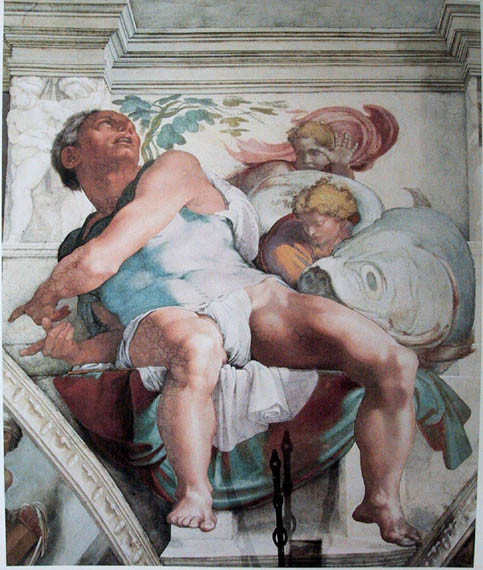
Jonah by Michelangelo


Saturday, 26 January 2013

An Inspiring Day in Leith


I had a great day today at the launch of the 'Peoples Map of Leith'.  The event took place at the Macdonald Road Library in Leith.


My colleague Ian Dyson has been doing the most amazing job over the last 2 years working for Bethany Christian Trust funded by Inspiring Scotland.  The Leith version of this project is called 'Inspiring Leith' and Iain has been doing a great job in bringing the communities of Lorne and Dalmeny together to have an impact in their community.  He has been involved in helping local people to set up the Lorne Cafe, the PDP Men's Games Cafe, Friends of Dalmeny Park Street, a Lunchtime Cafe at St Andrew church for pupils from Leith Academy and various litter pick ups including Kirk Street. 

Today's event was really well attended by a wide variety of people from Leith.  The Peoples Map was a great way of bringing old and young together to capture stories and memories of Leith.  As most people know Leith is a unique place and has a very different identity from Edinburgh.  I think they also have a football team who won the Scottish Cup a long time ago.
The peoples Map of Leith

I've been at some of Inspiring Leith's events before (like a great night of Curry making at Punjab'n de Rasoi on Leith Walk in December).  One of the things that strike me about community events is that they rarely go as planned.  Just like the community, these events can be very diverse, hard to predict and at times, a little bit messy.  This is often why so many of us don't really get involved in our communities other than in a very half hearted way.  It can be difficult, messy, exhausting and time consuming.  We also don't have much control when we get involved with our communities and most of us like to be in control!  I was talking to a leader of a Christian charity recently who told me that in a recent survey they did in a Scottish city most people surveyed responded that their community was no bigger than their immediate family.  What a sad indictment on 21st Century Scotland!  How can we change this?

1.  We need to get involved. 
Ian Dyson told me the story of a woman he met who was thinking of emigrating.  She was fed up with the litter, the drugs, the youths hanging about and the general depression around her community.  The next time he met her she had decided to stay and change her community.  Along with Inspiring Leith she organised a litter pick up in her street and established a Tenants Association to work together towards creating a better environment.  Imagine what would happen if every community had even one community activist like this?

Perhaps one of the greatest tragedies is that so often the church in Scotland is not leading community change.  Despite a church on almost every street corner the church is often the absent partner in community transformation.  But that hasn't always been the case.  When Thomas Guthrie walked the streets of the Cowgate and the Lawnmarket in the 1830's he was appalled by the 1-2000 'ragged children' he saw all around him.  He wrote, campaigned, organised, spoke and served until these children were fed, loved and educated.  He got involved. 

Thomas Guthrie's statue in Princes Street Gardens - 'a friend of the poor and the oppressed'
We might despair about our communities but Guthrie and others have shown that Christians can (and should) be at the forefront of community change.  As Tim Keller says 'the only way to reweave and strengthen the fabric [of community] is by weaving yourself into it.  Human beings are like those threads thrown together onto a table.  If we keep our money, time, and power to ourselves, instead of sending them out into our neighbours' lives, then we may be literally on top of one other, but we are not interwoven socially, relationally, financially, and emotionally.  Reweaving shalom means to sacrificially thread, lace, and press your time, goods, power, and resources into the lives and needs of others' (Generous Justice, p 177).

Ian Dyson in front of the Peoples Map of Leith
2. We need to listen to the community
If our communities are going to change, local people need to be involved with the solutions that will bring about transformation.  For too long communities have had services that have parachuted in to 'rescue' individuals and families.  Ultimately this solves very little.  On the other hand, community inspired projects create capacity and confidence for local people to take on other challenges.  As the Peoples Map of Leith showed very clearly, major projects like the Kirkgate Shopping Centre at the bottom of Leith Walk destroyed so much that was good in Leith and many feel the heart was ripped out of the community.  Local people know best and should be trusted about the future of their communities.

3.   We need to invest in community
At one time churches were at the heart of most communities in Scotland but sadly this is no longer the case.  People are now very reliant on community facilities.  The problem is that when councils close down these facilities the glue that often holds communities together is weakened.  The young people end up hanging on street corners, the older people become more isolated, the mothers who used to attend the mother and toddlers group get more stressed, and the ultimate effect is greater expense on other services.  This is why we can't afford not to invest in our communities.  For comparatively little expense, community facilities and investment provides much more in return with greater cohesion and a better living environment for all of us.

The Peoples Map of Leith show us how intertwined all our lives are.  We need each other.  We all need community.  Our cities prove Guthrie's point that 'the solitude of a crowd is the most painful of all.'  So many people are living in fractured and broken communities. 

Wouldn't it be great if the Christian church was leading community change once again?  Rather than seeing churches open for 3-4 hours per week wouldn't it be great to see them open every night and once again at the heart of their communities?  To do this we need to get involved, we need to listen to local people and we need to invest in the facilities and resources that can help community transformation.  This should be natural territory for Christians.  Why?  As Keller says 'God created all things to be in a beautiful, harmonious, interdependent, knitted, webbed relationship to one another.  Just as rightly related physical elements form a cosmos or a tapestry, so rightly related human beings form a community.  This interwovenenss is what the Bible calls shalom, or harmonious peace' (Generous Justice, p 173).  As Christians we should know what community looks like and feels like.  It is that shalom that Keller mentions - something we want for every community in Scotland.  We need to stop keeping it to ourselves and start living it!


Monday, 14 January 2013

Guthrie on the Lords Day

Like most Christians of his time Thomas Guthrie believed the Lords Day (Sunday) was to be kept as a special day of rest and to be used for public and private worship.  Like marriage the Lords Day is a creation ordinance.  If God rested on the seventh day, it is a fairly powerful argument that we need to rest one day in seven.  We believe that the Sabbath moved from Saturday to Sunday when Christ rose from the dead.  The Christian Sabbath, of course, used to be a great protection against exploitation of the poor and it is sad today  to see the Lords Day swept away in our 24 hour consumer driven culture. 


There are many stories about peoples negative experiences of the Lords Day, of swings being chained up on Sunday and children being cooped up all afternoon without being allowed to blow off steam.  No doubt there has been legalism in the past with greater concern on the outward form rather than the inner reality, but there can be little doubt that the loss of the Lords Day in Scotland has been a huge blow to our national life.  Research abounds that families are not spending enough time together and the decline in the traditional Sunday get together had has a damaging effect on family life.  It is unusual even to find Christians today who believe in the Lords Day and the Church is poorer as a result.  There is more teaching on the reformed view of the Lords Day at the bottom of this post.

We as a family, make the Lords Day a really positive family day and my hope is that my own children look forward to it as a day of rest, learning, enjoying God's creation and worshipping with the people of God.  Some of our best memories as a family are visiting our local Bellsquary Woods on a Sunday afternoon to feed the ducks.


Thomas Guthrie was a great proponent of the Christian Sabbath and was frequently asked to speak at rallies and meetings on the subject.  He often mentions how grieved he is about those who do not keep the Lord Days in his Memoirs.  Guthrie expresses his shock when travelling through London on his way to France in 1826; 'I see no religion here; they sell and buy openly upon the streets on Sunday.  I was shocked the first Sabbath upon leaving my lodgings, when a fellow in the street asked me if I would buy an umbrella.  When I went a little further I was asked to buy fruit' (Autobiography and Memoir, 1896, page 229). 

He was further shocked when he arrived in France and in a letter home on 17th January 1827 he says; 'It is on the Sabbath more than any other day that I think of you all at home: the awful scenes which obtrude themselves upon my view suggest by contrast the very different circumstances in which you are placed.  When I see the tricks of the jugglers and hear the music of the musicians, and observe the busy traffic of the merchants, and the reckless levity of the people on the Sabbath day, I think of the quiet streets of Brechin; and the stillness of our house is brought sadly to my remembrance, when I hear, in this one the light song instead of the sacred hymn, and see, instead of the Bible, the cards and dominoes upon the table, and the people, instead of repairing to church, driving off every Sunday night to the playhouse' (Autobiography and Memoir, 1896, page 231). 

Later on in his Autobiography when Guthrie was in Arbirlot, he talks about a farmer who took his harvest in on the Lords Day. The farmer was an adherent rather than a member of Guthries church but it was still very unusual to do any work on Sunday.   It must have been around around 1835 and it was a very wet summer.  Suddenly on a Friday the clouds began to clear.  Most of the community turned out on Sunday to thank the Lord for the change in the weather and were all set to get to work on Monday.  But one farmer had gathered his 'servants and cottars' together on Sunday and ordered them to gather in the harvest on the Lords Day.  Despite remonstrating with the farmer, the workers were conscious that their livelihoods depended on him and they carried out his orders with an uneasy conscience.  Being members of Guthries church, the workers were summoned before the session, but due to the circumstances, the session recommended to Presbytery that great leniency and tenderness should be shown to them. 

Guthrie says that the 'petty tyrant raged and fumed!  talking tall, big words about the liberty of the subject, and ending personal attacks on me by a challenge to defend myself and my Sabbatarian views at a public meeting in the church.'  Eventually a meeting was arranged in the manse and Guthrie says that the farmer had little to offer against his own thorough Biblical knowledge.  The farmer exerted great pressure to get the Presbytery to erase all records of the incident which they refused to do. 

It turned out that the farmer had harvested too early.  Guthrie tells us; 'Other farmers waited till Monday before they lifted stook or sheaf; and when they were stacking their crops in good condition, his barn-yard was smoking like a kiln.  His grain had not been ready for carrying on the Sunday, and every stack built on that day heated, as they call it, and had to be taken down on Monday; so this oppression of his underlings and breach of the Sabbath-day cost him, besides loss of character, loss of labour, of time and grain.  The people, as well they might, were much struck with this: his sin had found him out, and his neighbours who feared God, respected His law, and trusted in the old promise of harvest as well as seed-time, saw in the sound condition of their stacks and stack-yards how, in the words of Scripture, he that believeth shall not make haste'  (Autobiography and Memoir, 1896, page 108). 

Guthrie was a confessional Christian and held that the teaching of the Bible was summarised through the Westminster Confession of Faith and the Larger and  Shorter Catechism.  If you have never read them I would encourage you to read them.  One of the most helpful books for understanding the catechism is Thomas Watsons Body of Divinity published by the Banner of Truth.  Chapter 21 of the confession summarises the Biblical teaching on the Lords Day;

7. As it is the law of nature, that, in general, a due proportion of time be set apart for the worship of God; so, in his Word, by a positive, moral, and perpetual commandment binding all men in all ages, he hath particularly appointed one day in seven, for a Sabbath, to be kept holy unto him: which, from the beginning of the world to the resurrection of Christ, was the last day of the week; and, from the resurrection of Christ, was changed into the first day of the week, which, in Scripture, is called the Lord's day, and is to be continued to the end of the world, as the Christian Sabbath.

8. This Sabbath is then kept holy unto the Lord, when men, after a due preparing of their hearts, and ordering of their common affairs beforehand, do not only observe an holy rest, all the day, from their own works, words, and thoughts about their worldly employments and recreations, but also are taken up, the whole time, in the public and private exercises of his worship, and in the duties of necessity and mercy.


Saturday, 5 January 2013

Streets Paved with Gold - the London City Mission, Ragged Schools and Rice Christians

Once again I have to thank Rev Dr John Nicholls, Chief Executive of the London City Mission for sending me further material on Ragged Schools in London.  Below are a few quotes from chapter 4 of John's book co-authored with Irene Howat called Streets Paved with Gold, Christian Focus Publications, 2003.  If you want to read the entire chapter it can be downloaded from here and is used with kind permission from Christian Focus Publications. 


Within the chapter on Ragged Schools by Nicholls and Howat there is a good summary of a what a Ragged School was;

'An Edinburgh man, when asked to describe a Ragged School, said they were Sunday schools set up in the poorest parts where every house was ‘worn-out and crazy’ and nearly every tenant a beggar, or worse. ‘These schools, he said, were for ragged, diseased and crime-worn children, such as would not be admitted to any other kind of school.’ The one he instanced was in Field Lane, Smithfield, where 45 young people had to overcome the objections of their parents in order to attend; the parents viewing any possible reformation in their offspring as a potential loss of criminal earnings. Some of the children, who were aged six to 18, had already been in prison, and that, the Scot concluded, would be where they would spend much of the rest of their lives unless educated at the Ragged School. The teacher at Field Lane School was a big-hearted woman who did the work voluntarily three days a week' (Chambers’ Edinburgh Journal, 7th June, 1845).

I've already written here about the Ragged School Movement in London, the 'Devils Acre' and the involvement of Charles Dickens.  My family and I were down in London in October this year and visited Covent Garden for the first time.  It is an extremely nice part of London and it is hard to imagine the Dickensian situation described in Streets Paved with Gold ;

'As the men of the young London City Mission tramped the streets and alleyways of their districts, they met the conditions described by Dickens. ‘Covent-garden Market, when it was market morning, was wonderful company. The great wagons of cabbages, with growers’ men and boys lying asleep under them, and with sharp dogs from market-garden neighbourhoods looking after the whole, were as good as a party. But one of the worst sights I know in London, is to be found in the children who prowl about this place; who sleep in the baskets, fight for the offal, dart at any object they think they can lay their thieving hands on, dive under the carts and barrows,dodge the constables, and are perpetually making a blunt pattering on the pavement of the Piazza with the rain of their naked feet. A painful and unnatural result comes of the comparison one is forced to institute between the growth of corruption as displayed in the so much improved and cared for fruits of the earth, and the growth of corruption as displayed in these all uncared for (except inasmuch as ever-hunted) savages’ (Oliver Twist).
It is interesting to see the size and scale of the Ragged School Movement by 1876 and also to notice Lord Shaftesbury's multi faceted campaigning which included reform of abusive working practices;

'By 1861, 176 schools were connected to the Ragged School Union, which for the previous 17 years had worked ‘to give permanence, regularity and vigour to the existing Ragged Schools and to promote the formation of new ones’. Shaftesbury was chairman of the Union. Baptist Noel and R.C.L. Bevan, both closely connected with the London City Mission, were on the committee. So it was not only individual missionaries who were concerned to help the least privileged of the city’s children, the Mission’s leaders were also working to the same end. Mid-19th century evangelicals had a social conscience that led them to hands-on action; they also had a loud voice that got things done in government. While Shaftesbury was lending his name and support to the Ragged School Union, and visiting individual schools in the poorest parts of London, he was at the same time campaigning for there to be a limit to the number of hours children were allowed to work in factories and coalmines.' 


Perhaps one of the most interesting points raised in Streets Paved with Gold is the fear of creating 'rice Christians'.  This continues to be an issue today with many Christian organisations being accused of manipulation when offering food/clothes/help on condition of salvation.  I am often asked at meetings 'when do you get the gospel in?'  My response is usually to say that there was there was no sermon on the Jericho Road and the Cross itself was an act of love rather than a sermon.  When people walk in to a Night Shelter run by a Christian organisation or a church, cold, hungry and wet, the greatest act of love is to feed them, and give them somewhere warm to sleep. Perhaps the greatest example of this is Les Miserables where Jean Valjean is on the receiving end of great kindness and grace from a Bishop. Famously he says to Valjean 'Do not forget, never forget that you have promised to use this money in becoming an honest man. Jean Valjean, my brother, you no longer belong to evil, but to good.' This grace led to spiritual transformation without the need for a sermon. Preaching of course has a central place in the salvation of sinners but we need to remember that it is the Holy Spirit that regenerates and any church or organisation that seeks to bribe or manipulate people in a vulnerable position will only do huge damage to the kingdom of God.  Love, if it is true love must come with no strings attached.  In order to avoid the allegation of 'rice Christians' LCM pursued a policy of dividing evangelism and practical relief although it seems to have been fairly loosely interpreted;

'The LCM’s official policy had always been that the spreading of the gospel was paramount, and missionaries were forbidden to be involved financially with their people. As more and more missionaries became involved in the setting up and running of Ragged Schools, the Mission clarified this policy further. ‘The missionaries are most carefully to avoid the giving of temporal relief, as not their department of Christian effort, and as most materially interfering with the integrity of their especial work.  The missionaries are strictly forbidden from writing letters soliciting aid for persons in distress, or for objects connected with the district except with the special leave of one of the Secretaries … The missionaries must not make themselves responsible, or incur pecuniary responsibility in any form, for ... expenses attendant of Ragged Schools, rooms of meeting ...’ Behind these regulations lay not a lack of concern for the poor but the fear that, once missionaries were seen as a source of ready cash, it would be difficult for them to be sure of the honesty of those professing spiritual concern and conversion. The Mission was concerned to avoid the problem of what later became known as ‘rice Christians’. Yet the regulations were always interpreted fairly broadly, as in the case of a missionary who persuaded his local butcher and cookshops to help him feed starving children.'


There is also an interesting story about an LCM Missionary who is jumped on the way back from  a meeting.  It gives an insight in to the dangers missionaries placed themselves in on a daily basis;

'The Mission would probably not have been for the nervous or fearful either, as illustrated by one missionary’s experience of a visit to a Ragged School. The ‘little incident’ was reported in the February 1863 Magazine under the heading ‘A Missionary Garroted. ‘We fill up the remaining lines of this number with a narrative of a little incident which has just occurred to a missionary … Having received an invitation to attend a Ragged School Meeting in his old district (Deptford), he was induced to accept the invitation and pay a visit to his former friends. His return home from this visit was necessarily somewhat late, and in passing though Southwark near St. Saviour’s Church, he was accosted by two men, one of whom pinioned his arms and the other grasped his throat in his embrace. From the effects of the violence he is not yet free. He was robbed by them of his watch and the money which he happened to have in his pockets.’  Interestingly, his watch was returned to him by one of the thieves, but the other had no compunction about keeping a missionary’s money!' 

The chapter concludes with the legacy of the London City Mission and the ongoing work of the Shaftesbury Society the successor of the Ragged School Union;

'London City Missionaries have on many occasions been the agents of change, and this was certainly true in the establishment of Ragged Schools. From them, or associated with them, were the Ragged School and Chapel Union (again, with Lord Shaftesbury as its President), the Children’s Country Holiday Fund, Pearson’s Fresh Air Fund and, more loosely, the National Society for the Prevention of Cruelty to Children.  Thirty years after the first missionaries began Ragged Schools, their work came to an end. With the Education Act of 1870, elementary education was made available for all children, regardless of means. But while children’s educational needs were then catered for, their most basic welfare needs were not. The Ragged School Union became the Shaftesbury Society and continued to work for the good of the  children. Nor did the London City Mission opt out of education. Missionaries today are still involved in school work, after-school groups and children’s clubs. They still have a concern for the whole life of each child.'

I would like to recommend Streets Paved with Gold.  Remember you can read the whole of chapter 4 here.  It is an excellent read and the London City Mission continue to do a wonderful work which deserve our support and prayers.

Monday, 31 December 2012

Christian Assurance

In his Memoirs Guthrie talks about one of his parishioners, a weaver named 'James Dundas' who lived on the north-west boundary of the Arbirlot Parish.  Guthrie claims Dundas lived an isolated existence and had no society (beyond his wife) but that of God and nature.  Like others in rural Scotland at that time Dundas was known as a bit of a poet and known for 'lofty thoughts, and a singularly vivid imagination.'  Guthrie relates a story about Dundas and a loss of assurance on a Communion Sabbath;

'He rose, bowed down by a sense of sin, in great distress of mind; he would go to the church that day, but being a man of a very tender conscience, he hesitated about going to the Lords table; deep was answering to deep at the noise of God's waterspouts, and all God's billows and waves were going over him; he was walking in darkness, and had no light.  In this state he proceeded to put himself in order for church, and while washing his hands, one by one, he heard a voice say, "Cannot I, in my blood, as easily wash your soul, as that water wash your hands?" "Now Minister," he said, in telling me this, "I do not say there was a real voice, yet I heard it very distinctly, word for word, as you now hear me.  I felt a load taken off my mind, and went to the Table and sat under Christ's shadow with great delight" (Memoir and Autobiography, 1896, p 115).   


Assurance is a huge subject and one which many Christians struggle with.  We must distinguish between how we experience Christ on a daily basis (which can vary with our moods and emotions) and the ground of our salvation which is free unmerited grace of God which cannot be shaken by our feelings.  Professor John Murray very helpfully says; 'When we speak of the grounds of assurance, we are thinking of the ways in which a believer comes to entertain this assurance, not of the ground on which his assurance rests.  The grounds of salvation are as secure for the person who does not have full assurance as for the person who has (Collected Writings, Edinburgh, Banner of Truth 1980).