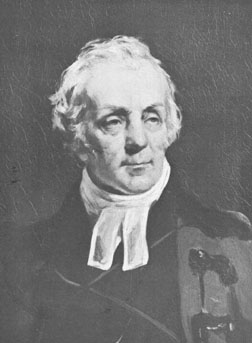
Thursday, 11 July 2013

Why Remember Dr Guthrie?


On 28th February 1873, Thomas Guthrie died.  One of my great goals over the last 5 years is to introduce his incredible legacy to a new generation 144 years after his death.  

Guthrie was one of the greatest preachers and social philanthropists of 19th Century Scotland.  He published numerous books, edited the Sunday Magazine (with a circulation of 100,000), was courted by some of the most powerful and richest people in the country and yet spent his life championing the cause of widows and orphans.  His statue in Princes Street Gardens stands as a memorial to this great man and yet hardly anyone, even in Christian circles, knows anything about him.  His books remain out of print and his incredible social philanthropy remains largely forgotten.  A little less than 1 year ago I set up this blog to try and re-establish Guthrie's reputation and share a little of his incredible life.  There are lots of articles on the blog about Guthrie's life and ministry like here.  As with most of these projects it has been me that has been most helped as I have spent hours researching and reading about one of Scotland's greatest leaders.  But why remember Guthrie today? Guthrie was (and still is) an inspiration, an example and a treasure of Christian wisdom.  Here are a few reasons why he should not be forgotten.

Firstly, Guthrie leaves us a legacy of biblical community engagement.  When Guthrie arrived in Edinburgh in 1837, the city was growing rapidly with the industrial revolution.   With large scale immigration from Ireland and large scale movement within Scotland from the country to the cities, Guthrie found extreme overcrowding combined with the most heart rending poverty within central Edinburgh.  Drunkenness was a widespread problem with many children being forced out to beg, borrow and steal to feed their parents’ habit.  There is a famous story told in Guthrie’s book Out of Harness that describes how Guthrie stood on George IV Bridge in Edinburgh just after he arrived in Edinburgh.  Looking down on his new parish known as the Cowgate he describes a living stream of humanity in motion beneath his feet.  A hand was laid on his shoulder and he turned around to find the famous preacher and social reformer Dr Thomas Chalmers.  Guthrie recalls; Hopeful of success, he surveyed the scene beneath us, and his eye, which often wore a dreamy stare, kindled at the prospect of seeing that wilderness become an Eden, these foul haunts of darkness, drunkenness and disease, changed into "dwellings of the righteous where is heard the voice of melody." Contemplating the scene for a little in silence, all at once, with his broad Luther-like face glowing with enthusiasm, he waved his arm to exclaim, "A beautiful field, sir; a very fine field of operation" Thomas Guthrie, Out of Harness, (Edinburgh, 1883, p 130).  This was the field in which Guthrie was to labour for the rest of his ministry.
  
Guthrie went on to conduct afternoon services in the Magdalen Chapel (made famous as a mortuary for the Covenanters) where he connected with the poor and marginalised in the Cowgate district of Edinburgh.  His great desire was to communicate the redeeming power of the gospel to those who were often shut out of the Scottish Church in 19th century Scotland. This involved the unreserved and free offer of the gospel which his sons underline in his Memoirs; “...he emphatically disapproved any attempt to square Scripture with the supposed requirements of a doctrinal system; "John," to quote a sentence from one of his discourses, "uses a very broad expression, 'Jesus Christ,' he says, '...is the propitiation for our sins; and not for ours only, but also for the sins of the whole world.' 'The whole world' - 'ah!' some would say, 'that is dangerous language.' It is God's language: John speaking as he was moved by the Holy Ghost. It throws a zone of mercy around the world. Perish the hand that would narrow it by a hair's breadth!" Thomas Guthrie and Sons, Autobiography and Memoirs, (London, 1896, p 510).  It was this theology and love for the poor that infused Guthrie’s preaching and evangelism and fuelled an irrepressible belief that the most unlikely candidate could be saved.  It was said of Thomas Chalmers that his Parochial System was a glorious enterprise of Christian aggression upon the regions of popular ignorance.  This similar approach was adopted by Guthrie who had a Christian vision for Scotland and believed that the Church should reach rich and poor alike.

Secondly, Guthrie leaves us an example of measured and balanced Christianity.  He was a man of deep convictions and spoke out against error and all forms of oppression but he was never sectarian or nasty in his contentions.  He went to great lengths to work with other Christians, particularly with regard to Ragged Schools.  When Guthrie was given a 'Testimonial' in February 1865 by the a committee made up Earls, Lords and even the Rt Hon Gladstone himself, he said; next to the approbation of God, of my blessed Master, and of my own conscience, there is nothing on which I set so high a value as the assurance this testimonial warrants me to entertain, that I have won a place in the hearts of other Christians besides those of my own denomination. 

Guthrie made time for family and it was his pattern to keep every evening free for his children.  As he says; On coming to Edinburgh, I resolved to give my evenings to my family; to spend them, not in my study, as many ministers did but in the parlour amongst my children Thomas Guthrie and Sons, Autobiography and Memoirs, (London, 1896, p 614). Guthrie loved his 6 sons and 4 daughters and once said I am rich in nothing but children. He loved reading fiction like Shakespeare’s plays and Walter Scott’s novels.  He was never happier, in later life, than with a fly rod in his hand at his favourite Highland retreat in Lochlee.  For 23 years Guthrie returned to this spot every summer and was given a cottage rent-free by Lord Dalhousie.  The Highland retreat allowed Guthrie to relax in the great outdoors and indulge his great passion for fishing.  Guthrie was a man of great passions but had a balance, a tenderness, a quick sense of humour and common touch that left such an enduring legacy in everyone he met.

Thirdly, Guthrie leaves a legacy of full church involvement.  As he says in his autobiography If the world is ever conquered for our Lord, it is not by ministers, nor by office-bearers, nor by the great, and noble and mighty, but by every member of Christ's body being a working member; doing his work; filling his own sphere; holding his own post; and saying to Jesus, ‘Lord, what wilt Thou have me to do?'  He had no time for one man ministries and pioneered what many today would call ‘team ministries’.  The difference with Guthrie was that he did this through the biblical system of elders, deacons and church members.  If there is ever a time in the churches history when we need to organise ourselves to effectively engage with the communities around our churches, it is surely today.

Fourthly, Guthrie leaves us a legacy in Christian boldness.  He was not a man who was afraid of speaking out against oppression and injustice.  His campaign for Temperance led him to campaign against the dram shops that were the ruin of thousands.  In a letter to his daughter in 1870 he says I preach everywhere that nothing will arrest, far less cure, the evil, but locking up every drinking shop in the land.  Guthrie also spoke out against the evil of slavery, even declining an invitation to go to America in 1859.  He says in his autobiography I have the highest opinion of the United States; and it is because I love them, that I wish this foul blot (slavery) removed from their escutcheon.  If that were done, it would be a happy day for the world...I will tell you plainly and publically why I will not go.  If I went I could not keep my temper! Thomas Guthrie and Sons, Autobiography and Memoirs, (London, 1896, p 666).  I have already written about his work with the Ragged Schools and how he tirelessly spoke up for those who had no voice.  Guthrie spoke eloquently with a range of Parliamentary Committees about their unwillingness to fully fund such a critical work.  He was also a frequent speaker on Sabbath Observance and on a whole range of other critical subjects.  Guthrie is an example to us of the need to be bold in the day in which the Lord has placed us.  The issues may have changed but the need to be faithful has not.

Finally, Guthrie leaves us a legacy of a Christ-centred life.  If anyone shows us what can be achieved for Christ, with vision and determination, it is Thomas Guthrie.  He lived for Christ, he preached Christ with tenderness and affection, and much like his Saviour he reached out to the broken and marginalised in word and deed.  Guthrie’s writings and sermons are full of love for his Saviour.  In a letter to a friend about the scientist Edward Forbes, Guthrie says What science is so noble as the knowledge of Jesus Christ?  What honours anywhere in the Temple of Fame like ‘the honour that cometh from God’ Thomas Guthrie and Sons, Autobiography and Memoirs, (London, 1896, p 646). 

As we look at Guthrie’s statue on Princes Street, with his hand around a little ragged child and a bible in his other hand, we see in Guthrie a man infused with love for Christ.  Following his Saviour Guthrie embodied love and truth and leaves us an enduring legacy which we would do well to learn from and emulate today.  Let me finish this article with a quote from one of Guthrie's sermons which beautifully sums up his theology and work; Never mistake the dead robes for the living body of religion.  Never forget that "to do justly, and love mercy, and walk humbly before God," is what the Lord requires of thee; that faith without works is dead; that form without spirit is dead; and that, the highest piety being ever associated with the deepest humility, true religion is like the sweetest of all singing-birds, the skylark, which with the lowest nest but highest wing dwells in the ground, and yet soars to the skies - (Thomas Guthrie, The Pharisee and Publican, The Parables, 1874).

Tuesday, 9 July 2013

Guthrie and the Sunday Magazine


When Thomas Guthrie (1803 - 1873) eventually had to leave his congregation of St John's, Edinburgh due to ill health in May 1864, it seemed that his ministry was at an end.  In God's providence, a new field opened up to him in the writing and editing of a weekly periodical the Sunday Magazine.  With the exception of a Plea for Ragged Schools first published in 1847, Guthrie's other publications, until 1864, were mainly published sermons; the Gospel in Ezekiel in 1855, The City its Sins and Sorrows in 1857, Christ and the Inheritance of the Saints in 1858 followed by The Way to Life and Speaking to the Heart.  We might wonder what would have happened if Guthrie had been given such an opportunity earlier in his ministry.  As Dr Tweedie said of Guthrie; 'I wonder [if] Dr Guthrie did not discover his literary faculty twenty years before he did, if he had, his usefulness would have been trebled' (quoted by Oliphant Smeaton in Thomas Guthrie, Famous Scots Series).

Many of Guthrie's later books were first serialised in the Sunday Magazine which he co-edited with Dr Blaikie.  Guthrie was involved in editing and writing the magazine from 1864 and was editing The Lepers Lesson 10 days before his death in February 1873.  The magazine continued after his death and was published until 1905.  It is incredible to think that even with a credible and widely read Christian magazine called Good Words (published by Dr Macleod) the Sunday Magazine still had a circulation in the early days of over 100,000!

The magazine was pitched at ordinary people and was designed to be read on the Lords Day.  Sold weekly for sixpence, the Sunday Magazine was printed on good quality paper with attractive illustrations from wood engravings drawn by several different artists including George John Pinwell.  The magazine embodied much of Guthrie's deeply held principles; the uniting of the classes, social philanthropy, evangelical ecumenicalism, education of the poor and solid, accessible doctrine.  Guthrie outlines the purpose of the magazine as follows;

to make the Sunday a more pleasant as well as a more profitable day to thousands; to make our magazine plain to common people without being vulgar, interesting to cultivated minds without being unintelligible to men of ordinary education; to make good our entry into cottages as well as drawing rooms; to be read by people of all Christian denominations; to be of no class, of no sect, of no party, but belonging to all, and profitable to all... 


By todays standards Guthrie's writing style would be described as 'flowery'.  His illustrations can be full of vivid imagery from nature and  foreign lands but often last for pages which can be weary to the modern reader.  Despite this, it is remarkable that Guthrie, with all his other commitments was able to write so much, so often and to such a high quality.

Many of Guthrie's articles were eventually published; Man and the Gospel (1865), The Angels Song (1865), The Parables (1866), Our Fathers Business (1867), Out of Harness (1867), Early Piety (1868), Studies of Character (1868 and 1870) and Sundays Abroad (1871).  The sheer volume of writing is staggering when one considers that Guthrie was writing weekly.  As well as articles, Guthrie was flooded with letters from all over Britain offering articles for the magazine.  Often he found it difficult to say no and a few articles appeared in the Sunday Magazine that were not in complete accord with the title and objects of the magazine.

In God's providence, when Guthrie was shut out from the pulpit, God opened a far greater field of service where he could influence an audience a hundred times that of St Johns.  In a letter he wrote to one of his sons in 1870 after crossing the Channel, he described how he met a Scottish engineer on the boat.  The man, from Berwick-on-Tweed, approached Guthrie and told him that despite living for many years in St Petersburg, he was a regular reader of the Sunday Magazine.  As Oliphant Smeaton says 'the Sunday Magazine proved a blessing to many in the highest and best sense of the word, and from 1865 to 1873 Thomas Guthrie's personality was impressed on every page of it.'

One of the greatest tragedies is that none of Guthrie's books remain in print today.  One of my greatest hopes is that Ragged Theology might be the means of stirring up some interest in Guthrie again so that some of his works can be republished.  In the meantime, much of the Sunday Magazine is available online and can be viewed here.

Saturday, 22 June 2013

Building hope in Glasgow

One of the many privileges of my job with Bethany Christian Trust is to see some of the amazing things God is doing around Scotland.  Yesterday I was through in Glasgow visiting Stuart Patterson who planted a church in Easterhouse over 2 years ago.  I met Stuart when he was sharing his testimony at a prison bible study 2 weeks ago.  He shared how he had been drawn into the gang and drug culture of Easterhouse on the 1980's but was wonderfully saved.  After a period in Teen Challenge Stuart has returned to Easterhouse to set up a church in an old bingo hall in the Shandwick Shopping Centre.


Like so many large housing schemes people immediately associate Easterhouse with poverty, gang violence, unemployment and addiction.  Built in the 1960's Easterhouse, at its peak, housed 60,000 people.  It's hard to believe but the older residents testify to the fact that the scheme was built in the 1960's without shops, schools, leisure centres or any other amenities.  By the 1960's and 70's there was territorial battles and the scheme was made famous by the intervention of Frankie Vaughan.
 
Easterhouse had a strong gang culture in the ‘60’s and 70’s, mainly amongst the boys but in some sections of the girls as well…You learnt how to do three things. You learnt how to fight, make people laugh or how to run really fast! I was known as Artillery because I stood at the back and threw bricks, and when things turned sour, I ran.             2000 Glasgow Lives interview with A McSherry


Today the population of Easterhouse is around 26,000 with many of the same social problems as it had 40 years ago.  Adult male unemployment is running at 60% with high levels of addiction, poor health indicators and high levels of deprivation.

Stuart has found a fantastic location for Easterhouse Community Church.  Situated right in the heart of the community in the Shandwick Shopping Centre its great to see an old bingo hall being used as a place of worship.  The church has a job club running on a Tuesday and Thursday and is trying to reach out to some of the people that even some of the core funded job agencies won't touch.  Stuart spends a lot of time talking to shoppers in the shopping centre and all like all successful church planters realises the importance of relationships and a long term commitment.


Stuart took me to see some of his old battlefields from the 1980's and it was good to see that peace had broken out!  There is still some of the old territorial battles going on but it has reduced from what it was even 20 years ago.  Stuart is keen to harness this fierce local identity as he seeks to create different worship locations around Easterhouse.
 
 
It was also good to see the offices of Family Action in Rogerfield and Easterhouse after hearing so much about them over many years.  Bob Holman has always been one of my heroes in social work and deserves a huge amount of credit for what he has done with FARE.  Well done to Duncan Bannatyne for investing some of his wealth in the work of FARE.
 
 
After a hearty fry up with Stuart it was time to head off to see Shirley Berry at the Findlay Family Network.  Started 7 years ago the FFN are doing some great work around Maryhill and Possilpark.  Working in partnership with Findlay Memorial Church and Clay Community Church the FFN are supporting different levels of community support.   Their focus is on families and are doing a great work with some of the most vulnerable families in North West Glasgow.  They are respected partners with both social work and education who see them as competent providers of excellent family work.  It was humbling to visit The Grove in Possilpark and hear from staff and volunteers about the various community projects that were running.  The Grove is a partnership between FFN and Clay Community Church and they use shop front on Saracen Street.  It is great to see the church right in the heart of the community.


A great day in a very warm Glasgow!  God is doing some great things though some amazing people.  The church in many parts of the country is reengaging with the community and making an increasingly significant impact.  I was reading yesterday from Joshua chapters 1 and 2 about the children of Israel being commanded to go across the Jordan in to the promised land.  There was anxiety about going in to a new place where there would be new challenges. Three times in chapter 1 the Lord says 'Be strong and of good courage' (ch 1 v 6, 7 and 9).  We need a similar courage to engage with some of the most hard to reach communities in Scotland today.  We need to pray for pastors like Stuart Patterson who are willing to plant a church in an area with huge social issues. 
 
While there are many challenges, there are also many promises is the bible that if we reach out to the poor, God will bless.  In Isaiah 58 v 10 God says; 'If you pour yourself out for the hungry and satisfy the desire of the afflicted, then shall your light rise in the darkness and your gloom as the noonday.'  We need to put aside the denominational divisions that are hampering so much of the work in Scotland today.  Out of the 26,000 people who live in Easterhouse Stuart estimates that there only 300 who attend church.  The need is huge and our great priority needs to be the gospel of redeeming grace.  As Thomas Guthrie once said 'Let each select their own manageable field of Christian work. Let us embrace the whole city, and cover its nakedness, although, with different denominations at work, it should be robed, like Joseph, in a coat of many colours. Let our only rivalry be the holy one of who shall do most and succeed best in converting the wilderness into an Eden, and causing the deserts to blossom as the rose' (The City its Sins and Sorrows, Guthrie, 1857, p 111).


Sunday, 16 June 2013

Reflections of a forty something father


Train up a child in the way he should go: and when he is old, he will not depart from it.
Proverbs 22 v 5-7

We are so busy giving our children what we didn't have, that we don't have time to give them what we did have.
Dr James Dobson

Today was fathers day.  For many it was a heart breaking day as they yearned for a father they never had or perhaps for a father who didn't live up to what they wanted.  Others reflected on a father who has passed away and who they continue to miss dearly.  I'm so thankful for my own dad and all he taught me about fatherhood.  He wasn't perfect but he was always there for me growing up.  Juggling a busy ministry with a family couldn't have been easy.  Coping with the death of my sister over 30 years ago must have been an incredible blow - and yet he persevered.  His patience with my teenage tantrums are something I can only appreciate now as a father! I love how he always wore a tie - even on holiday.  I can still remember his reaction when I announced one Saturday afternoon that I was off to meet a girl.  It wasn't so much shock as incredulity.  I still chuckle thinking about it.
 
 
Sometimes people think that because I have 4 boys that I must know something about being a dad.  Fortunately that illusion disappeared some time ago.  As a sinner I realise how imperfect I am as a father.  When you are a parent there is nowhere to hide.  Your frustrations are on display and even when you say sorry you can never take back an angry outburst or a sarcastic put down.  The only way to be a great dad is to be honest with my kids that I am a flawed, broken sinner who needs grace daily to live for God's glory.  I need to point them to a perfect heavenly father who can be their guide in a confusing and often hostile world. 
 
Having said all that, there a few things I have learned along the way that may help future dads on the rollercoaster that is fatherhood. 
 
1. Don't be frightened to be a man
Children, particularly boys, need a man to look up to.  I meet a lot of guys nowadays who seem to be embarrassed by manliness.  Don't get me started on male grooming (that can perhaps take up a whole other blog) but some men seem to struggle with the fact that God has made us different.  We were meant to be providers and protectors in God's original design.  He wants us to lovingly and sacrificially lead our families in a clear direction.  Of course we need to discuss and lovingly listen to our wives and children but God wants us to men - to lead, provide and protect.  Like most men I have often put my work before my family.  I feel sad and guilty about that.  But I'm also proud that my kids see a dad who works hard and puts food on the table.  My 7 year old doesn't want a dad who crochets with him - he wants me to play football with him 24 hours a day.  My 13 year old wants a dad who will take him camping and do outdoor stuff with him.  By any assessment I'm not really Bear Grylls but this summer, God willing, we will go camping (very close to toilets and a shower block).  My point is that sons want a father who is a man.  God put men and women together in marriage because they give very different things to their kids.  Don't be frightened of these differences celebrate them.


2. Get the order right
This is critical if you want to be a good dad.  A godly Christian minister once said to me when I was a young, struggling father; 'children need three things: love, security and discipline - in that order'.  I've never forgotten that advice and every time I've gone wrong as a dad it is when I get the order wrong.  My early years as a father were just embarrassing.  I was a disciplinarian always laying down the law.  As with the gospel, love needs to come first.  When my sons understand how much I love them, discipline becomes so much easier.  They also need security.  I'm away with work fairly regularly but generally if the boys know when you are leaving and coming back they can cope.  Love needs to be communicated in the ordinary of everyday life; the chat on the way to school, the arm around my boys while watching Match of the Day, taking them to shinty training or taking them to get a new pair of trainers.  It all communicates love and concern and boys need tons of it.  Let's remember to have lots of fun with our kids.  Life is tough so lets give our kids plenty of happy memories.  Rob Parsons in his book The Sixty Minute Father quotes a father; When I'm gone and my children talk about me, I would love them to say that I taught them great things, to look at the world with large eyes, to reach their potential and to care for those who are weak.  But I would wonder if I had missed it if they didn't add, 'But what we remember too is that he was fun to be with.'
 
 
3.  Put God first
I genuinely weep over some of my parenting in the last 13 years.  Sleep deprivation can do some awful things to the best of us.  But something I was brought up with and have always done is family worship.  Every night my wife and I gather the kids at around 8:30 to sing a psalm, read about 10 verses from the bible and say a short prayer.  It is one of the best times of the day.  Currently we are reading Proverbs and talking about the need for wisdom.  I am much more challenged than the kids because I have been reading this book for 40 years and I seem to be more foolish than ever.  My challenge to other parents is simply this 'where are your kids getting their values from?'  As well as topping up their emotional tanks with love and cuddles every day we need to teach them about a great God and a loving saviour.  We need to teach them about the values of the bible and how they can make sense of a confusing and sinful world.  Kids need to see the reality of our faith as well as the theory.  Of course they need to sit under good preaching but they are only in church 1-2 hours a week.  What they see and hear in the home is much more critical to their faith.  I'm not saying this happens often but recently we had an amazing answer to prayer.  Our car broke down and we had just spend a fortune on it.  To my shame I felt a little angry with God that he could have allowed this to happen.  As a family we prayed.  Amazingly, and out of the blue somebody sent us some money which covered a large part of the cost of the new car.  If our kids see God working through the practical issues of life, if they see God as a reality in our lives they will be more attracted to the gospel.
 
 
4.  Remember grace
In all my many, many failures as a dad, I need to remember God's grace.  When I fail, I need to confess and repent but then I need to dust myself down and get on with it.  If our children leave home when they are 18 we have 6570 days with them.  We think we have our kids for ever but we don't.  Let's not miss these precious days that God has given to love our kids.  Don't be crippled by past failures.  Yes we've made mistakes but kids are resilient and understanding.  They also have short memories.  We need to say we are sorry and do everything we can to be a loving parent.  Our kids don't understand the pressures of our work - all they want is some quality time with their dad doing the things they want to do. God is gracious and patient with us and we need to be the same with ourselves and our kids.  I have always loved Psalm 103 v 13 'Such pity as a father hath unto his children dear, like pity shows the Lord to such as worship him in fear'.  I hope and pray that I can be a better dad as I try to learn from my many mistakes but I am so thankful that I am upheld by a perfect father in heaven.  My prayer is that my sons will see something in me that will draw them to that loving heavenly father and that they will grow up to be great fathers to their children.


Monday, 22 April 2013

The Original Edinburgh Ragged School (1)

‘They perish in the open street, - beneath the pitiless pelting of the storm, - of cold, and hunger, and broken hearts.’
Bishop Horsley

A Fine Field of Operation

Thomas Guthrie was nothing if not an orator.  His descriptive, and (at times) flowery preaching and writing was always stirring and moving.  In his Seed Time and Harvest of Ragged Schools which came out in three stages or ‘pleas’ from 1847-1860, Guthrie walks us through the sights of Edinburgh.  Having taken us round the beauty spots he takes us to a darker side of the nation’s capital; ‘The sheep are near the slaughter-house, - the victims are in the neighbourhood of the alters.  The mouth of almost every close is filled with loungers, worse than Neopolitan lazzaroni, - bloated and brutal figures, ragged and wretched old men, bold and fierce looking old women, and many a half-clad mother, shivering in cold winter with her naked feet on the frozen pavement, and a skeleton infant in her arms.  On a summer day...careering over the open ground...are crowds of children.  Their thin faces tell how ill they are fed.  Their fearful oaths tell how ill they are reared (Seed-Time and Harvest of Ragged Schools, Thomas Guthrie, 1860, page 7).  This is the parish to which Guthrie was called in 1837 and his response to these ‘ragged children’ is his lasting memorial.

A Difficult Problem

In early 19th century Scotland, many children caught up in crime, no matter how petty, were languishing in prison.  Others were flogged or hanged without mercy.  Writing in 1845, the Governor of the Edinburgh jail, Mr Smith, stated in a letter that 740 children under 14 (245 of which were under 10) had been committed to prison in the previous 3 years. In 1847 5.6% of the population of the Edinburgh jail were under 14 years of age with a further 552 prisoners aged between 14-16.  The need for a different response was gaining momentum by the early 1840’s but the movement needed a figure head and someone who could articulate the cause eloquently.  They found this in Thomas Guthrie who took up the campaign for ‘Ragged Schools’ with great relish.  Guthrie’s campaign for ragged schools was on many different levels; financial, spiritual and moral.  He was appalled at the money being wasted on prisons and often stated that an ounce of prevention is worth a pound of cure.  The development of the Ragged Schools was to prevent the apprentice criminal making criminality a career choice.  Guthrie saw in these street children the potential for moral and spiritual change; bedded in their dark and dismal abodes, precious stones lie there, which only wait to be dug out and polished, to shine, first on the earth, and hereafter and forever in a Redeemer’s crown’ (Seed-Time and Harvest of Ragged Schools, Thomas Guthrie, 1860, page 52).

The original ragged school which is now part of 'Camera Obscura' beside Edinburgh Castle
 
 The Ragged School Inspiration

The first or ‘original’ ragged school in Edinburgh was established in 1847 in a small room on the Castle Hill.  The main building that was eventually used is now part of Camera Obscura and the open bible can still be seen above the door with the words ‘Search the Scriptures’ (John 5 v 39) engraved on it.  Guthrie says that the inspiration for the ragged school movement was from John Pounds of Portsmouth (1766-1839).  Pounds was a dockyard worker who at the age of 15 fell in to a dry dock and was crippled for life.  As he recovered he taught himself to read and write and became a cobbler.  Pounds started to teach local children to read and write free of charge.  He also taught them carpentry, how to cook and how to repair shoes while offering them food and shelter at the same time. 

Guthrie discovered John Pounds by visiting an Inn in Fife one day in 1841 and seeing a portrait of Pounds above the fireplace.  Guthrie continues the tale; I took up that man's history, and I found it animated by the spirit of Him who 'had compassion on the multitude.' John Pounds was a clever man besides; and, like Paul, if he could not win a poor boy any other way, he won him by art. He would be seen chasing a ragged boy along the quays, and compelling him to come to school, not by the power of a policeman, but by the power of a hot potato. He knew the love an Irishman had for a potato; and John Pounds might be seen running holding under the boy's nose a potato, like an Irishman, very hot, and with a coat as ragged as himself (taken from "Self Help" by Samuel Smiles, London, 1859).  Guthrie was also inspired by Sheriff Watsons Ragged School established in Aberdeen in 1841.  Watson was seeking to develop an early diversion from custody.  While Guthrie’s Ragged Schools always remained voluntary, a degree of compulsion was used by Sheriff Watson with the only alternative being prison.

A New Curriculum

The original Ragged School brought together different responses to the needs of these desperate children; education, regular meals, clothes, ‘industrial training’ and Christian instruction.  All this was done in an environment of discipline and structure although there is never a sense that the schools were harsh or austere.  Guthrie was no great fan of corporal punishment and instead encouraged staff to win over children with kindness; these Arabs of the city are wild as those of the desert, and must be broken into three habits, - those of discipline, learning and industry, not to speak of cleanliness.  To accomplish this, our trust is in the almost omnipotent power of Christian kindness.  Hard words and harder blows are thrown away here.  With these alas they are too familiar at home, and have learned to be as indifferent to them as the smith’s dog to the shower of sparks (Seed-Time and Harvest of Ragged Schools, Thomas Guthrie, 1860, page 25).

The ragged children who attended the school/s did not remain overnight but were in school for 12 hours in the summer and 11 hours in the winter.  The day started at 8am with the rather painful sounding ‘ablutions’ and the children were dismissed at 7:15pm after supper.  Guthrie describes the daily routine; ‘in the morning they are to break their fast on a diet of the plainest fare, - then march from their meal to their books; in the afternoon they are again to be provided with a dinner of the cheapest kind, - then back again to school; from which after supper, they return not to the walls of an hospital, but to their own homes.  There, carrying with them a holy lesson, they may prove Christian missionaries to those dwellings of darkness and sin (Seed-Time and Harvest of Ragged Schools, Thomas Guthrie, 1860, page 25).
 

The door to the Original Ragged School with the inscription 'Search the Scriptures' 

 
A Cloud Gathers

As with every great venture, there was controversy.  An anonymous writer in a newspaper suggested that Roman Catholics were excluded from the school.  When it was proved that nearly a half of the children were of Irish and presumably Roman Catholic descent, the Ragged School was then accused of indoctrinating these children and effectively excluding them.  A public meeting was called in July 2nd 1847 and Guthrie, Sheriff Spears and Dr Lindsay Alexander were pitched against Lord Murray, Professor Gregory and an advocate called Mr Simpson.  Guthrie rose to the occasion; Mark how I stand.  I say that the responsibility of the religious upbringing of the child lies upon the parent; and if there be no parent, or none to act a parent’s part (if the parent for instance, be a worthless, profligate mother), on whom does the responsibility next lie?  I join issue with the Catholic here.  He says that it lies with the priest.  I say it lies with the good Samaritan who acts the parents part.  I say it neither lies with the priest nor the Levite who passed by on the other side; it lies with the man who resolves, by the strength of his own exertions, to save the poor outcast child (Autobiography and Memoirs, 1896, p 449).  Guthrie was always ecumenical in the Biblical sense of the word, but he never compromised on Christian education.  Perhaps one of his best quotes sums up his view; the Bible, the whole Bible, and nothing but the Bible; the Bible without note or comment – without the authoritative interpretation of priest or presbyter – as the foundation of all its religious teaching, and of its religious teaching to all (Autobiography and Memoirs, 1896, p 455).

I’m going to do a second article on the effects of the Original Ragged School in Edinburgh and the wider movement around the country, but let me leave you with the thought that we can all achieve a huge amount with a God given vision, plenty of energy and the help of a committed group of fellow Christians.  Many scoffed at Guthrie when they first heard of his vision, but as we look at his statue on Princess Street we see a wonderful legacy.  Underneath his statue it reads; a friend of the poor and the oppressed.  And what if he had failed?  As he said himself of his vision for ragged schools; It is better far in such a cause to fail, than to stand idly by and see the castaway perish.  If the drowning man sinks before we reach him, it will be some consolation to reflect that we did our best to save him. (Seed-Time and Harvest of Ragged Schools, Thomas Guthrie, 1860, page 54).
 

Friday, 5 April 2013

Thomas Guthrie in Lairg and the Preachers Stone at Badbea

We have been up in Lairg on holiday over the last week.  It has been great weather and my crash course in lambing has been a steep learning curve!  We have also been looking after some pigs which has been an even more interesting experience.  Feeding them every morning brings a whole new dimension to the story of the Prodigal Son!


I enjoyed preaching in the newly refurbished Gair Hall in Bonar Bridge last Lords Day and in the beautifully situated Rosehall Church in the evening.  Rosehall is next to Altass where we have been going for holidays over many years.  I have never found a more beautiful glen in Scotland although parts of Argyll come very close!


There is an interesting reference to Lairg in Guthrie's Autobiography and Memoirs.  He was touring the Highlands for the 'Manse Fund' from July 1845 - July 1846. Guthrie toured the country gathering stories (and more importantly money) in response to the many ministers who had left their manses after the Disruption.  It was in the Highlands of Scotland that Guthrie came across some of the most tragic situations which he vividly conveys in his letters. 
 
Writing from Lairg on June 25th, 1845 Guthrie writes to his wife that he had visited the tent where the Free Church congregation were worshipping.  After the Disruption in 1843 the Lairg Free Church congregation had to worship in a canvas tent for for two years at the foot of Clais-nam-Buaile.  Eventually they were allowed to build on the other side of the river and took the ferryboat to church until a swing bridge was eventually built.
 
Guthrie, in his letter, also spoke of visiting Creich (Bonar Bridge);
 
Close by the Free Church at Creich I saw an interesting place, - the rock under whose shadow, and the lake by whose side, the people worshipped God for more than two years, summer and winter, no less than thirty years ago.  A Moderate was intruded: the people took up their bibles and left the church empty.  The Seceders had not penetrated these Highland fastnesses, nor was there any Free Church then to help them; so they met under this rock, and the 'Men' conducted their services for two years under the open sky.  Afterwards they had to meet in different parts of the parishes; but now, after thirty years of separation, the Disruption - as they call it, the Blessed Disruption - has brought them together again in the Free Church (Autobiography and Memoir, 1897, p 419).
 
After a few enquiries this week we managed to locate the Preachers Stone.  It is along the shore of Loch Migdale and the start of the path is just below the home that Prof John Murray was born in - Badbea.  It is a beautiful, gentle walk suitable for children (our 3 year old managed with minimal carrying).  The walk is maintained by the Woodland Trust and you can find more information here.
 
The stone is about 1 mile along and is right beside the shore.  'The Men' would have preached up the hill to the people like a natural amphitheatre.  My uncle, William Murray, who has lived in Lonemore (near Dornoch) for over 70 years had never visited the stone so it was wonderful to get his picture beside the stone and chat to him about some of the local history. 


My uncle William Murray at the preachers stone, Badbea.


James and Calum on the preachers stone.  Loch Migdale in the background.


As mentioned above, Thomas Guthrie's name will be for ever be connected with the 'Manse Fund'. After the Free Church Disruption of 1843 there was incredible suffering as ministers and their families left their churches and manses over the issue of state interference in the spiritual decision making of the church. The issue at stake was the headship of Christ over the church which dates back to covenanting times. It is an incredible testimony to these men that loss of their homes was no deterrent to following their principles.
 
Thomas Guthrie was approached in May 1845 to become the figure-head of the Manse Fund. In customary humility, when Guthrie was pressed upon to take on this role by none other than Dr Thomas Chalmers, he responded at the first Glasgow meeting by saying;
 
It was no office I sought myself. I would much rather have stayed at home with my own flock and my own family: I have had enough of speaking, and travelling, and fighting and I am tired of it: and were it not that I have reason to believe that I am the last 'big beggar man' you will ever see, and were it not that the cause has all my sympathy and deepest interest, I would have been happy had the Church chosen one better fitted for it than myself; but I am sure that in one respect no man could be better fitted, for if I have not a head, I have at least a heart for the work (Autobiography and Memoirs, 1896, p 417).
 
The Manse Fund had the ambitious target of raising £50,000 immediately with the ultimate target of £100,000.  Before the Manse Fund had started £50,000 had been raised for the School Building Fund with the combined total raised by the Free Church by 1845 the incredible sum of £697,000. Guthrie expressed serious concern that the Manse Fund would stretch the generosity of Free Church people to the limit but he needn't have worried.  After Guthrie had toured 13 Synods and 58 Presbyteries in less than a year, he was able to announce to the General Assembly of June 1846 that £116,370 had been raised for the Manse Fund. Ultimately there were 6,610 subscribers who gave an average of £19 each.
 
The scale of the Manse Fund can be seen by the fact that 700 manses were needed to respond to the huge demand after the Disruption. It is interesting that manses were to be build in the following order of priority;
  • Highland Parishes
  • Lowland County Parishes
  • Small Towns
  • Large Towns

This is Presbyterianism in action. The wealthier city congregations were seeking to alleviate the incredible amount of suffering in the Highlands.  The strong were seeking to support the weak. 
 
During his tour of the Highlands, Guthrie also felt some anger at the way the godly had been treated.  There is a tragic account of his visit to Tongue where he visited a Mr Mackenzie and his son who having left the manse were living in 'mean cottage school house under the lee of a heather hill'.  Both father and son were gravely ill due to the conditions they were living in and Guthrie's hatred of oppression and injustice was stirred as it so often was.  Writing to Mrs Guthrie he says;
 
Every daisy on the road had its cup closed; and surely, thought I, if God in this storm protects these little flowers, He'll not dessert these two faithful servants - the venerable old man and a son worthy of his sire.  I confess when, on my return, I again passed the Manse and looked on its smooth lawn, and chimneys, and neat trim walks I felt my corruption rising (Autobiography and Memoir, 1896, p 421).
 
The Manse Fund was perhaps Guthrie's greatest legacy.  It is unlikely that anyone else could have achieved what he did in such a short space of time.  His energy and oratory enabled the Manse Fund to smash its original target.  Numerous ministers and their families owed a huge debt of gratitude to Guthrie for providing the resources to build manses so that the gospel could continue to prosper not just in the Highlands but across the whole of Scotland. 


Tuesday, 2 April 2013

The Life and Times of Thomas Chalmers (1780-1847)


by Donald John Maclean (Cambridge) http://jamesdurham.wordpress.com/
“Thomas Chalmers, as all the world knows, was born in the Fifeshire town of Anstruther in the year 1780”.  If that was true in 1908 when William Beveridge published his “Makers of the Scottish Church” what a change the past 100 years have seen.  In his own timeframe Thomas Carlyle called him “The chief Scotsman of his age,” he even came to the notice of Karl Marx who labelled him the “arch parson.”  When he died it was said that though it “was the dust of a Presbyterian minister which the coffin contained; and yet they were burying him amid the tears of a nation, and with more than kingly honours.”  But today, Chalmers is a forgotten and largely neglected figure.  And that is nothing short of tragedy.

Thomas Chalmers
 
And in many ways it is hard to explain.   Some people are forgotten because they don’t publish much.  This is not true of Chalmers.  His collected writing published in his lifetime run to 35 volumes.  Some people might be forgotten because they don’t found anything that endures.  But to take two institutions that Chalmers founded, the Free Church of Scotland and New College Edinburgh – both exist today.  Nor was his influence confined to Scotland.  William Wilberforce heard him preach and said that "all the world was wild about Dr. Chalmers."  In America the theologians of Princeton Seminary read and appreciated Chalmers.  Samuel Miller said that from Chalmers writings he received “impressions of his moral and heavenly grandeur.”
 
But perhaps there are two reasons for his neglect.  First, he addressed the specific political and economic problems of his day, as well as the spiritual, and so he wrote a number of works which are heavily dated.  Even faithful sons of the Free Church of Scotland may struggle to get overly excited by works like “On Political Economy in connection with the Moral State and Moral Prospects of Society” with chapters like “On the Increase and Limit of Food”.  Nor is a work like “On Cuvier's Theory of the Earth” going to grab attention today.  And because he wrote much on social themes, secondary literature on Chalmers has often focused on these areas – perhaps creating the false impression of a man who spoke to his time, but does not have much to say to ours.  Second, perhaps some who we might expect to warm to Chalmers are put off because of his view of the relation between science and Scripture.  Chalmers for example accepted, and it is fair to say enthusiastically embraced, the views emerging in his day over the old age of the earth.  Now, we will return to critical of Chalmers on this topic later – but we shouldn’t throw the baby out with the bathwater and ignore Chalmers because of his views here.  I remember a few years ago I was talking to someone at a wedding and as we struck up conversation he asked who I was reading.  I replied “Thomas Chalmers”.  He looked puzzled and said, “but he was a raving liberal.”  While we have to wrestle critically with Chalmers here, to call him a liberal is a tragedy.
 
Now, it is hard to capture the genius of Chalmers in a brief discussion – due to the sheer scope of his life.   His life moves from being a minister in a rural church, to leading large city congregations, to being a professor of moral philosophy, to being a professor of theology.  He leads over 1/3 of the Church of Scotland out of the denomination to form the Free Church of Scotland, launches a massive church building programme and sets in place the structures to support the church.  All the while he maintains renown as an orator, preacher, political economist, philanthropist, educationalist, ecclesiastical statesman and – above all – as an incomparable motivator of his fellow Christians. 
 
What we will try and do is look at his life and draw lessons from it as we go through.
 
Chalmers the Moralist
Chalmers was born in 1790, as we all know, in Anstruther in Fife.  He grew up in a godly home as the 6th of 14 children.  His parents were sincere Christians.  At the age of 15 he went to St Andrews to study and there fell into the deadly trap of “Moderatism.”  It is important to remember that there have been few if any “golden ages” in church history.  We might think of the late 18th and early 19th centuries as prime candidates for such.  The age before Darwin, the age before higher criticism, the age before atheism was the “default” position.  But no.  Unbelief manifests itself in many ways, religious as well as irreligious.  For instance, it is hard to imagine a more religious people than the Pharisees, and yet it is also difficult to imagine a group of people so dead in unbelief.  And so it was in the Scottish Church.  Vital religion had largely died.  There was the form of godliness but the power had long gone.  To be “evangelical,” to be “serious” about religion was no less despised in those days than our own, particularly among ministers.  The great, and none too tactful, Highland minister Lachlan MacKenzie of Lochcarron (1754-1819) said “If people go to perdition in these days it is not for want of ministers.  The clergy are likely to become soon as plentiful as the locusts in Egypt, and which of them is the greatest plague of the two, time and the experience of the church will discover.”
 
So when Chalmers arrived in St Andrews, destined by his father for the gospel ministry, he encountered the chilling and deadly atmosphere of Moderatism.  Chalmers said there that he “inhaled not only a distaste only, but a positive contempt for all that is peculiarly gospel.”  When he finished his studies he eventually was called to be the pastor in Kilmany.  At this stage he is unconverted with, as he said, a “contempt” for what he later embraced as the gospel.  He rejected the substitutionary atonement of Christ, “The tenets ... that the Author of Nature required the death of Jesus for the reparation of violated justice are rejected by all free and rational enquirers.”  He rejected justification by faith alone, “Let us tremble to think that anything but virtue can recommend us to the Almighty.”  And this he did as one who subscribed to the Westminster Confession of Faith!
 
Chalmers also had a very low view of the ministry, holding an assistantship in Mathematics at the University of St Andrews and offering lectures on science as well.  Part of his natural drive and self-confidence can be seen in that he lost his position at the University through criticising his senior college in Mathematics.  In a statement which he was later to bitterly regret he reflected his derisory view of the ministry by stating that: “The author of this pamphlet can assert from what to him is the highest of all authority – the authority of his own experience – that, after the satisfactory discharge of his parish duties, a minister may enjoy five days in the week of uninterrupted leisure for the prosecution of any science in which his taste may dispose him to engage.”  Some years later when this statement was thrown back in his face a converted Chalmers said, “Alas!  So I thought in my ignorance and pride.  I have now no reserve in saying that the sentiment was wrong, and that, in the utterance of it, I penned what was most outrageously wrong.  Strangely blinded that I was!  What, sir, is the object of mathematical science?  Magnitude and the proportions of magnitude.  But then, sir, I had forgotten two magnitudes – I thought not of the littleness of time – I recklessly thought not of the greatness of eternity.”
 
Chalmers Conversion
As Chalmers went about his leisurely ways he was brought into the valley of the shadow of death.  His brother and sister died of tuberculosis in 1806 and 1808 respectively.  As the “clergyman” in the family he had to pastor them in their dying days.  His brother asked Chalmers to do something that was distasteful to him - read aloud puritan sermons to him!  His sister asked him to do something even more uncomfortable, namely sing the psalms to her!  Over this period he sang through the Psalter 5 times to her.  Chalmers then became ill himself in 1809.  While he recovered, he faced more crises, for example, another sister died.  Through this God was working in Chalmers, and in 1810 as he was reading William Wilberforce’s Practical View of the Prevailing Religious Systems of Professed Christians a revolution came about in his spiritual life.  Chalmers was a converted man.  He later wrote: “as I got on in reading it, [I] felt myself on the eve of a great revelation in all my opinions about Christianity … I am now most thoroughly of the opinion, and it is an opinion founded on experience, that on the system of “Do this and live” – no peace and even no true and worthy obedience, can ever be obtained.  It is “Believe in the Lord Jesus Christ and thou shalt be saved.”  When this belief enters the heart, joy and confidence enter along with it.”
Application: Perhaps somewhere around the UK today there is someone labouring in a parish, confused in unbelief, whom God will use, like Chalmers, to awaken a nation.  May this be our prayer!
Chalmers Renewed Pastorate in Kilmany
 
A passion was ignited in Chalmers heart for the bible.  Before his conversion, one of the members of his congregation said to him: “I find you aye busy, sir, with one thing or another; but come when I may, I never find you at your studies for the Sabbath.”  “Oh!” said Chalmers, “an hour or two on the Saturday evening is quite enough for that.”  But regarding the converted Chalmers the same man said, “I never come in now, sir, but I find you at your bible!”  To which Chalmers responded: “All too little, John, all too little”.
 
Application: Perhaps we lack Chalmers power because we lack his acquaintance with the word of God?
This love of the Bible became evident as Chalmers threw himself wholeheartedly into the work of the emerging Bible society movement.  Remember the Bible Society began in 1804 in London, and the Scottish Bible Society was founded in Edinburgh in 1809.  Being new, being innovative was something that never troubled Chalmers.
 
As well as the work for Bible Societies, and related to it, was Chalmers passionate attachment to mission and the emerging missionary societies.  In 1813 he published a sermon “The two great instruments appointed for the propagation of the Gospel.”  This was a powerful sermon on the text “faith comes by hearing, and hearing by the word.”  Here is his conclusion: “Those to whom Christ is precious will long that others should taste of that preciousness.  Those who … [rejoice in] the sufficiency of the atonement will long that the knowledge of a remedy so effectual should be carried around the globe … In a word those who love the honour of the Saviour, will long that his kingdom be extended till all the nations of the earth be brought under his one grand and universal monarchy – till the powers of darkness shall be extinguished – till the mighty Spirit which Christ purchased by His obedience shall subdue every heart, shall root out the existence of sin, [and] shall restore the degeneracy of our fallen nature…”  As a result of this he became a director of the London Missionary Society. 
 
Application: Chalmers, like another great Presbyterian Charles Hodge, was a man who transcended denominational boundaries.  He embraced the new voluntary societies for bible distribution and mission.  He worked with those outside the Presbyterian tradition.  How comfortable are we doing working with those outside our circles?
 
Another example of Chalmers willingness to embrace change was that he was willing to adapt the form of his language to his hearers, stating that, “I feel that I do not come close enough to the heart and experience of my hearers, and begin to think that the phraseology of the old writers must be given up for one more accommodated to the present age.”  It was said that [Blakie] “not a vestige did he borrow of traditional forms, hardly any of the traditional phraseology.” In his famous sermon on “the common people heard him gladly.”  Chalmers said that “We hear of the orator of fashion, the orator of the learned, the orator of the mob.  A minister of Jesus Christ should be none of these; and if an orator at all, it should be his distinction that he is an orator of the [whole] species.”  That was his goal, to speak to all in his age, whatever their station in life.
 
Chalmers was by all accounts an extraordinary preacher.  This he achieved while breaking all the conventional rules of pulpit eloquence of his day.  First, he read his sermon from a manuscript rather than preaching extemporaneously.  Second, he suffered from “the obstacles of a provincial education, an ungraceful person, and an unharmonious voice.”  But despite this he had a power that captivated.  Hear the classic description of his preaching: “His voice is neither strong nor melodious, his gestures neither easy nor graceful; but on the contrary exceptionally rude and awkward; his pronunciation not only broadly national, but broadly provincial, distorting every word he utters into some barbarous novelty … He commences in a low drawling key, which has not even the merit of being solemn, and advances from sentence to sentence, and from paragraph to paragraph, while you seek in vain to catch a single echo that gives promise of what is to come … But then, with what tenfold richness does this preliminary curtain make the glories of his eloquence to shine forth … I have never heard either in England or Scotland, or in any other country, any preacher whose eloquence is capable of producing an effect so strong and irresistible.”
Two key things about Chalmers preaching:
-          “By far the most effective ingredient of good preaching is the personal piety of the preacher himself.”  This is the “spiritual conviction” that was identified as the key to his preaching.
-          “The great aim of our ministry is to win souls.”
Application: Is this the great aim or our lives, and our ministries?
W.G. Blakie stated that “his whole discourse was … a boiling, foaming current, a mingled stream of exposition illustration and application, directed to the one great object of moving his audience to action.  His soul was so penetrated with his subject, his whole nature was so roused and electrified by it, that others could not but be roused and electrified too.”
 
Two Glasgow Pastorates
In 1815 Chalmers was called to Glasgow, to the Tron Parish Church.  Some of his greatest work was done in Glasgow.  When he arrived he was responsible for a parish of around 12,000.  His church could accommodate 1300.  And of his church, which was full, less than 100 people came from his parish.  His parish was working class - his congregation was the emerging middle class.
 
And so what would you do?  You have a large congregation. You have a lot of duties to perform.  Surely you are content with your lot?  Well this is where Chalmers “heart for mission” begins to shine through.  We have seen it a little in his support for bible societies, in his willingness to adapt his language, but here it really shines out.
First, he engages in systematic parish visitation.  That is over 2,200 households.  Over two years he visits them all.  As part of this he reenergises the eldership in his parish increasing the number of elders from 8 to 25 one year after moving to the Tron.
Second, he organised mid-week services in conjunction with visitation.  For many this was the only service they would have.  Remember the church was woefully small in comparison to the number of people in the parish.  Recall also that in those days you had to pay a “seat rent” to get a seat in the church - which for those who were poverty stricken was not straightforward!
Third, he embraced the emerging Sunday School movement.  He organised his parish into districts giving each teacher a manageable size of catchment area.  He established 47 schools in his parish.  A number of his teachers went on to be ministers having received a grounding in visiting working class homes, getting to know the conditions in which people lived, and trying to make the Christian faith understandable to groups of children who, one suspects, would not have necessarily been the most willing listeners.
Fourth, he fought against the secularisation of the ministry.  It is almost staggering to think what the duties of a parish minister involved in those days.  From administering what today is social security benefit, to sitting on town councils debating whether pig or ox broth was better for the ill.  He stated “I am gradually separating myself from all this trash, and long to establish … [that my] entire time [be] disposable to the purposes to which the apostles gave themselves wholly, that is the ministry of the word and prayer.”
Application: Chalmers was clearly comfortable breaking the accepted mould.  Be that in adopting contemporary language.  Be that in taking the church out in to the world.  Be that in embracing bible societies and the missionary movement.  Chalmers clearly and wisely distinguished between what were fixed principles and matters simply of preference and form.  What can we do today?  How do we become “all things to all men” without abandoning our duty to “contend earnestly for the faith”?
Application: Breaking the mould can be a bad thing.  When in Glasgow Chalmers published works (e.g. Astronomical Discourses) accepting the emerging geology.  This raises the question of whether Chalmers’ embrace of the teachings of natural science ultimately set the scene for the embrace of higher criticism and the death of the Free Church he founded. For myself, I think the answer is that he set a trajectory which could, and sadly did, lead the Free Church astray.
Iain Murray correctly notes that for Chalmers “the care of souls was not to end in the pulpit.  He pressed upon his divinity students what became known as the “aggressive principle”, that is to say, they must take the gospel to the people; the unchurched must not be left alone, rather they must be pursued wherever they are to be found.”
A couple of interesting anecdotes:
·         Chalmers drew huge crowds and at times this could present a danger to safety.  On one occasion he later related to a fellow pastor the steps he had taken to reduce crowds:  “I preached the same sermon in the morning and for the very purpose of preventing the oppressive annoyance of such a densely crowded place I intimated that I should preach it again in the evening.  Have you ever tried that plan?”  “I did not smile,” said the other minister, “I laughed outright.  ‘No, my friend,’ I replied.  ‘Very few of us need to resort to special means to get thin audiences!’”
·         Chalmers was preaching in the High Church, Edinburgh. A report of his sermon: “In those days his action was violent in the extreme.  The whole energy of the man seemed to be thrown into his limbs: the pulpit cushion got such a dusting as it had not known since the days of John Knox.  He was enveloped in a cloud of dust – his gown flew around his shoulders; but he held his audience rapt until one was unconscious of time and space.”
In order to cope with the large scale population movements and to try his ideas in a new setting Chalmers took advantage of plans to set up a new parish, St Johns.  He also wished to demonstrate that the Church itself through the diaconate could care for the poor, without specific state levies.  He also set up schools for general education, with a Christian base.
The success of the St John’s experiment has been much debated.  What is clear is that a passion for church planting to meet population growth, combined with a revitalisation of the deaconate to care for the poor, aligned with his earlier revitalisation of the eldership was a key achievement, and a large step to better days ahead.
Chalmers the Professor
In 1823 Chalmers moved back to St Andrews to be Professor of Moral Philosophy.  Why did he do this?  Chalmers was aware of St Andrews as a stronghold of the “moderates”.  Why did he abandon his church in Glasgow?  Well the answer I think lies in strategic usefulness.  What he could do in one congregation himself, he could inspire scores of students who passed through his classroom to do.  It was as a teacher of the rising generation he felt he could do most for “the Christian good of Scotland.” 
 
When in St Andrews Chalmers remained an enthusiastic supporter of mission – encouraging the first Church of Scotland missionary Alexander Duff as he went to India.  He was chair of the St Andrews Missionary Society.  While in St Andrews 300 students passed through his hands.  He used his planned influence well, having many groups of students round for meals and holding fellowships on Sabbath evenings. After 5 years in St Andrews, (now 1828) during which his wife threatened to become a non-conformist to escape the moderatism of the Church of Scotland, Chalmers transferred to the Chair of Divinity in Edinburgh.  Here he became the leading evangelical in the church, and in 1832 was appointed moderator of the General Assembly.
 
Chalmers had a longstanding vision that “through every district of the land there would be a church to which the people may repair.”  In 1834 he was appointed to lead a new “Church Extension Committee.”  Over the next 7 years he raised funds equivalent to £22m today and saw 220 new churches planted.
 
In Edinburgh he was appointed to the Church’s foreign mission board, he was a patron of the Edinburgh University Missionary Association and took an honorary position on the Board of Foreign Mission of the Presbyterian Church in America.  However, by this time the balance of power in terms of mission support in Scotland swung from voluntary societies to the Church.  That I think was a good thing.
 
In Edinburgh Chalmers was able to influence a rising generation.  Names you may have heard of came under is sway: Robert Murray McCheyne, William Cunningham, Andrew Bonar, Horatius Bonar, George Smeaton and others.  One example of what he did is on Saturday mornings he got his students to gather for prayer in New College and in pairs visit the poorest areas of the city.  One of those who gathered was McCheyne and it was said of him that “In Chalmers more than any other person that McCheyne found the mould for his ecclesiastical and religious thought.”
 
The Disruption
Through the labours of Chalmers and others an evangelical revival had been occurring and in 1834 they had the majority in the Church.  A controversy had been brewing for some time over the right of congregations to choose their own ministers, rather than the rich landowners imposing their choice.  The 1834 assembly gave congregations the right to veto the appointment of any minister that they could not agree to.  This led to a significant dispute between the Church and the state which eventually was decided in the House of Lords against the rights of the Church.  Believing that “the crown rights of King Jesus” had been violated by the state Chalmers led nearly 40% of the ministers out of the Church of Scotland to form the Free Church of Scotland.  Soon 800 churches were established and a new theological college in Edinburgh founded. Some key features of Chalmers vision for the Free Church:
-          Strong churches support the weak by giving funds to support their work.  This was known as the “sustentation fund” and was a practical expression of Presbyterian unity.
-          Passionately evangelistic e.g. reaching out in the West Port of Edinburgh
-          Non-denominational e.g. despite being the leading founder of the denomination, Chalmers could say “Who cares for the Free Church compared with the Christian good of Scotland.”
-          Committed to evangelical unity e.g. Chalmers was one of the founders of the Evangelical Alliance.
What is a real testament to Chalmers is that when the Free Church split from the Church of Scotland, every single missionary identified themselves with the new Free Church!
Chalmers died 4 years after the Free Church was founded.  Andrew Bonar said: “Remember that very few men, and very few ministers, keep up to the end the edge that was on their spirit at the first.” Chalmers did.
Application: How does Chalmer’s founding a new denomination fit with Christian unity?  Why split the church over the election of ministers when there is a “plague” of Moderate ministers in the church?  Which if any of these should have split the Kirk?
 
So, the life of Thomas Chalmers.  Wouldn’t it be good if a day could come when articles on Chalmers could once again begin: “Thomas Chalmers, as all the world knows, was born in the Fifeshire town of Anstruther in the year 1780”!